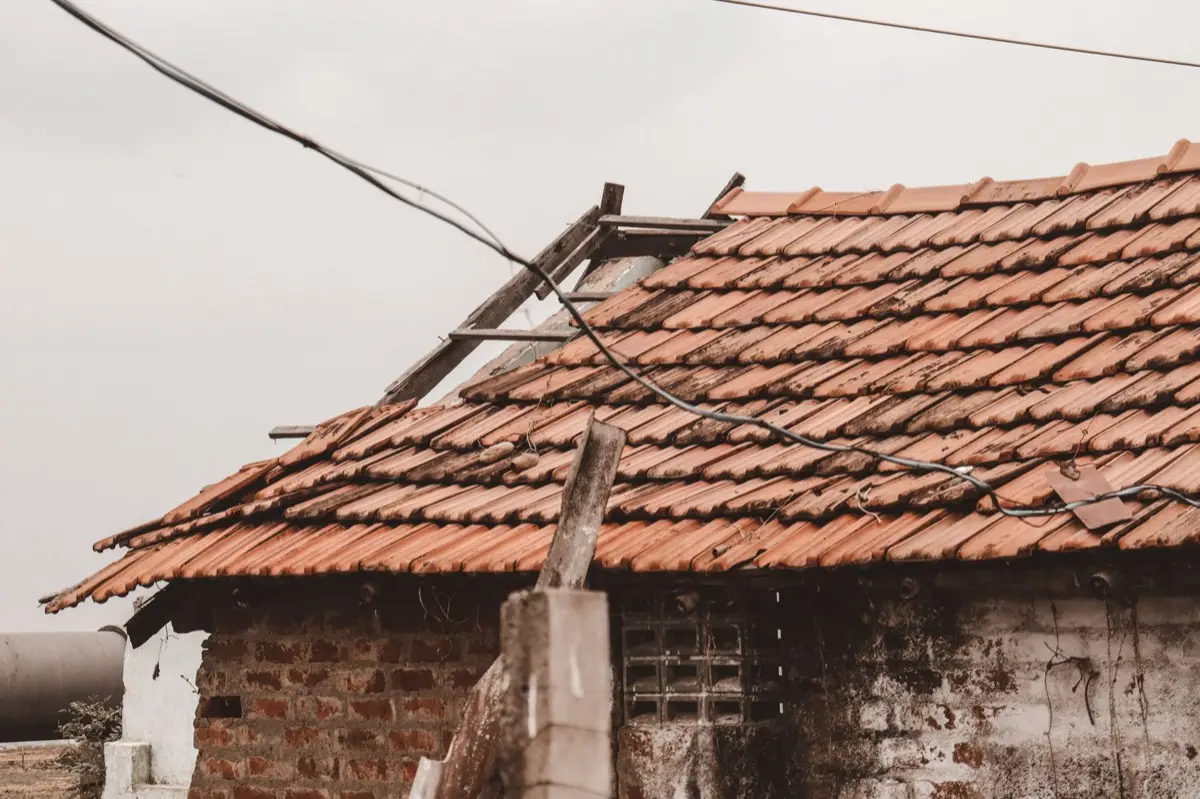
Wind does not dent a roof. It pulls on it, and what fails is a strip of glue. That is why a wind-damaged shingle can look flawless from the sidewalk, and why a wind claim argues nothing like a hail one.
It also explains the crews: wind losses draw the same door-knocking, selling the same product — a whole new roof — for what is frequently a slope repair.
What wind damage on a roof actually is
Wind meeting a house is deflected over and around it, and the result is uplift: suction pulling up, not pressure pushing down. It is not even across the plane. In a paper given to the American Meteorological Society's 2010 hurricane conference, Marshall, Morrison, Herzog and Green of Haag Engineering put the peak uplift at the windward corners, rakes, eaves and ridges — discontinuities where the airflow separates and goes turbulent. Damage starts there.
On a shingle the mechanism is stranger than deck uplift. What matters is the strip cantilevered downslope of the sealant line: wind stagnates at the base of the tab while air accelerating over the top generates lift. The paper's comparison is an aircraft wing, and it is exact, including the nasty part — lift deforms the tab, the deformed tab presents more area, and more area makes more lift.
So what holds your roof on is not the nails. Nails resist sliding. The seal strip, a band of factory adhesive cured by sunlight that bonds each course to the one beneath, resists peeling — and peeling is what wind does. Break it and the failure modes run in Haag's order: creasing, flipping, tearing or removal, abrading from flying debris.
The crease is the whole argument
A crease is a fold across the tab that does not come out — the shingle bent past the point of returning, the mat broken along the line. It is the wind equivalent of a fractured mat under hail, and what an inspection hunts for.
Haag's 2017 paper on misconceptions of wind damage states the rule cleanly: any sealed-down shingle affected by wind leaves lasting evidence, in the form of creases, folds, tears, missing shingles or portions of them. Their testing found creases present even on new, pliable shingles at speeds up to 175 mph, although observing them took very close inspection.
Read that in both directions. Real wind marks the shingle it moved, and an unmarked shingle was not moved, however confidently someone in your driveway says otherwise.
Why a failed shingle looks perfect from the ground
Once the wind stops, the tab falls back down. Gravity returns it to about where it started, over a broken bond, with a fold set into it. From the street, a roof.
So a wind assessment is hands-on: tabs lifted, course by course, slope by slope. Hail is found by pressing down on a bruise; wind is found by lifting up. A drone photographs a roof beautifully and settles nothing about a seal strip.
An unsealed shingle is not automatically a damaged shingle
This is what separates an honest report from a sales document, and it cost Haag a published reversal: the 2017 paper withdrew the position that a merely unadhered shingle is wind damage. A shingle unsealed but not creased, folded, torn or missing is not evidence that wind did anything.
Shingles unseal on their own. University of Florida research by Craig Dixon, under Forrest Masters, surveyed in-service roofs and found a distinct pattern of partial unsealing on 70 percent of them — 19 of 27 roofs, laminate and three-tab alike. Roofs generally stayed sealed for the first four to five years, after which the frequency trends upward.
Marshall's crews gave it the diagnostic that ends most arguments: unbonded overlaps on every directional slope are not weather. Wind does not arrive from four directions with exactly enough force to unbond overlaps on each. Racked installations unseal in alternating overlaps, diagonal ones on the left or right laps — installation patterns showing through, plus contaminated sealant and thermal cycling.
Nor is shingle splitting: horizontal splits open between the two lines of restraint, vertical ones over the butt joints below. Asphalt shrinking, found the week a storm passed.
Storm damage roof inspection: what changes when the storm was wind
A hail inspection is a count inside a chalked ten-by-ten square. A wind inspection is not: the question is not how many per hundred square feet but where, facing which way, and did the seal hold. A report worth reading contains:
- Tabs lifted by hand, at the eaves, rakes, hips and ridge first, then the field
- Which slopes carry creases and which way they face, set against the recorded wind direction for the storm date
- The starter and first course specifically — a badly installed starter leaves the bottom course bonded to nothing
- Ridge and hip caps, including whether the fasteners reached the deck through a high-profile ridge vent
- A photograph of a creased tab while it is lifted, because a tab lying flat photographs as undamaged
- The rest of the property — fences, screens, siding, gutters — which record direction the way soft metal records hail
Four kinds of wind, and the patterns they leave
Adjusters read pattern before damage, and the storm type sets it.
| Storm | What it does to a roof |
|---|---|
| Straight-line thunderstorm wind | Outflow, no rotation. Divergent — debris lies one way. Usually one or two slopes |
| Downburst or microburst | A concentrated straight-line hit, under about 2.5 miles across and lasting minutes, with gusts that can top 100 mph |
| Tornado | Convergent or circulating. Damage points several ways in a short distance and can reach opposing slopes |
| Hurricane | Hours of loading, direction rotating as the storm passes — the one event that plausibly hits every elevation |
The National Weather Service calls a thunderstorm severe at a 58 mph gust — a warning threshold, not a damage threshold, though the two get quoted as one sentence. What decides the outcome is the condition of the seal strips it lands on.
The consequence is practical: a squall with one gust front damages the slopes that faced it, so a claim covering all four slopes after a single straight-line event describes weather that did not happen.
Where a roof gives way first, and why
Haag's survey after Hurricane Frances covered 280 asphalt roofs on the Florida coast. Only 44 percent of the three-tab roofs came through with little to no damage, against 87 percent of the laminated ones — partly weight, partly that a cut-out tab behaves like a flap on a wing. Once the bond broke, the tab folded back, creased and flipped until it tore away, and on racked installs the losses ran in a zipper up the slope from eave to ridge.
Installation was worse than the products. Of eleven roofs examined closely, ten had been fastened improperly — nails or staples driven in or above the sealant strip, missing the underlying shingle entirely. Later work found a correctly located fastener roughly doubles pull-through resistance. RICOWI's report on Hurricane Ike found failures concentrated at hip and ridge caps, eaves and rakes, the same high-suction locations, and newer roofs outperforming older ones.
A wind class is worth buying, but it assumes a seal that sealed and a nail in the line.
Si el viento levantó tejas y quieres que revisemos pendiente por pendiente, levantando las tejas a mano y fotografiando cada pliegue, te lo explicamos todo en español.
Insurance claim wind damage roof: why the answer is often a repair
Wind is a named peril on most homeowners policies, so coverage is rarely the fight. Cause and age are: whether the creases line up with the storm's direction and date, or whether the roof was unsealing on its own schedule. Building the file is the half you control.
Two wind-specific items decide more money than anything else on the sheet.
A creased shingle is damaged while still on the roof. It is the most-disputed line in wind claims, because nothing is missing and nothing leaks. A folded mat is a shortened service life, not an open hole.
Unbonded shingles have a published repair that is not a roof. The Asphalt Roofing Manufacturers Association's re-sealing method uses quarter-sized dollops of asphalt roofing cement under the tabs — for laminates, four dollops about an inch in from the ends. Haag's own summary is that repair or replace is typically an economic choice: a fair basis for a conversation, a poor one for a tear-off nobody has justified. The legitimate counterweight is matching, since on a discontinued product a repair can leave a visible band across the front of the house.
Signing in the week after the windstorm in California
Wind contracts get signed faster than hail contracts, because a missing shingle looks urgent in a way a bruise does not. Wind claims are also settled as partial repairs more often, the outcome people sign before hearing. Whether you can get back out afterward, and from what date, is statute rather than paperwork.
California ties every cancellation window to the day you sign, not to what your insurer decides - so a denial three weeks later leaves you with no statutory way out. You get three days normally, five if you are a senior citizen, and seven only where a disaster has actually been declared by the President, the Governor or your local executive officer. The notice must be twelve-point boldface, immediately next to where you sign.
The deductible on a wind loss in California
Read your own first: many policies in wind-exposed areas apply a separate wind, hail or hurricane deductible set as a percentage of the dwelling limit rather than a flat sum — commonly 1 to 5 percent, per the Insurance Information Institute. That makes it a large number — and it is exactly what the offer to handle your deductible is offering to handle.
California has no contractor-specific rule against a roofer eating your deductible, which is unusual for a big storm state - the section listing prohibited acts in home improvement contracts says nothing about it. That is not permission. A roofer who quietly covers your share while billing the carrier the full amount is assembling a false claim, and that is a crime under Penal Code section 550 for the roofer and for you.
Bottom line
Wind pulls, and the seal strip is what gives. Look for creases, folds and tears — not dents, and not merely unsealed tabs, which most aging roofs have anyway. Expect it directional and starting at the edges, expect one storm to account for one or two slopes, and have someone lift tabs by hand. Then read the scope: if a loss on one elevation became a whole roof, ask what changed in between.
Salinas Roof Pros handles storm damage restoration, documented roof inspections and roof leak repair across Salinas and the Salinas Valley. Call (866) 456-4374 for a slope-by-slope wind assessment with the lifted tabs photographed and the creases mapped against the storm direction — including the times the answer is that the seals let go on their own.
Ready for a free quote in Salinas?
Salinas Roof Pros — free estimate, clear scope, no pressure. Use the form on this page or jump to the homepage quote.
Related services in Salinas
Salinas Roof Pros money pages — go straight to the service you need.
- Roof Leak Repair →
Salinas hands leak repair a problem most cities do not have. The rain arrives in a narrow winter window and then stops for months, so for half the year the roof will not reproduce the leak on its own and guesswork fills the gap.
- Storm Damage Restoration →
Storms here are not the storms the roofing industry advertises for. There is no hail season, no named-storm season, and no impact event.
- Residential Roof Installation →
This is the roof that goes on when there is nothing to remove. A new house, an addition, a second unit, an outbuilding, a deck going back to bare plywood.
- Commercial Roof Installation →
On a commercial roof in the Salinas Valley the machinery decides the roof's life. Cooling, refrigeration and ventilation equipment sits up there year round, and what it does to a membrane is a mechanical problem before it is ever a weathering problem.
- Roof Replacement →
Most of the replacement estimates written in this city should have been repair estimates. We say so on the roof, before anyone measures for material, because a tear-off is the largest single check most households here will write against their house.
Frequently asked questions
What does wind damage on a roof look like?
A crease, a fold, a tear, or a shingle that is gone. Haag Engineering's 2017 paper on wind damage to asphalt shingles puts it as a rule: any sealed-down shingle affected by wind leaves lasting evidence of the event, and that evidence is creases, folds, tears, missing shingles or portions of shingles, or some combination.
In their testing, creases were present even on new pliable shingles at wind speeds up to 175 mph, though finding them took close inspection. Wind does not leave dents. That is hail.
Can a roof have wind damage with no missing shingles?
Yes, and this is the case people lose. A shingle is held down by a strip of factory adhesive that cures in the sun, and when that bond breaks the tab lifts, folds back and creases along its top edge. Gravity then lays it flat again.
From the driveway the roof reads as intact, while a fold has been permanently set into the tab. It is found by hand, by lifting tabs course by course, which is why a wind inspection looks nothing like a walk-around.
Does homeowners insurance cover wind damage to a roof?
Wind is a named peril on most homeowners policies, so the coverage question is usually settled before the argument starts. The argument is about cause and age: whether the shingles were damaged by the storm on the date claimed or were already unsealed and brittle.
Check one thing in your own policy first, because it surprises people — many policies in wind-exposed areas carry a separate wind, hail or hurricane deductible calculated as a percentage of the dwelling limit rather than a flat amount. The Insurance Information Institute puts those percentages commonly in the 1 to 5 percent range.
How much wind does it take to damage a roof?
There is no clean number, and the honest reason is that the roof matters more than the storm. The National Weather Service calls a thunderstorm severe at a 58 mph gust, which is a warning threshold and not a damage threshold. ASTM D3161 tests new shingles at fan speeds from 60 to 110 mph.
Neither describes a fifteen-year-old roof whose seal strips have already let go, which can lose tabs at speeds a new roof shrugs off — and whose neighbor's new roof, in the same gust, does not.
Is wind damage a repair or a full replacement?
More often a repair than the post-storm sales pitch suggests, and that is the genuine difference between wind and hail. Wind damage tends to be directional and concentrated at edges, so it lands on one or two slopes rather than the whole roof.
Unbonded but undamaged shingles have a published fix that is not a new roof: the Asphalt Roofing Manufacturers Association's re-sealing method, quarter-sized dollops of asphalt roofing cement under the tabs. Haag's own summary is that the repair-or-replace choice is typically an economic one, which is not the same as a technical necessity.
How do you tell straight-line wind from a tornado?
By whether the debris diverges or converges. Straight-line winds are thunderstorm outflow with no rotation in them, so trees, fences and debris all lie in roughly the same direction — the direction the wind was traveling when it reached the ground. Tornado damage converges or circulates, and debris ends up pointing several ways within a short distance. It matters to a roof claim because a rotating storm can credibly damage slopes facing opposite directions, and a straight-line gust generally cannot.
Local context
How this applies in Salinas, CA
Every article here is written from roofing work done in Salinas and the Salinas Valley, so the numbers reflect local labour, permit and material costs rather than a national average. Your own job can land either side of them depending on access, the condition of what is already there, and the materials you pick — reinforced walkway pads over single-ply membrane, condensate lines re-routed to a drain or scupper, prefabricated equipment curbs with an integral cant.
The way to turn any of this into a real answer is to have someone look at your actual situation. The free estimate is free, itemized and written down, with no deposit and no obligation. Call (866) 456-4374 or start on the Salinas Roof Pros homepage.
Areas Salinas Roof Pros covers
Salinas first, then the surrounding communities of the Salinas Valley. Each has its own page with local detail rather than a copy of this one:
- Seaside, CA — Monterey County, population 32,366
- Hollister, CA — San Benito County, population 41,678
- Monterey, CA — Monterey County, population 30,218
- Soledad, CA — Monterey County, population 24,925
- Marina, CA — Monterey County, population 22,359
- Greenfield, CA — Monterey County, population 18,937
Or jump to the full list of Salinas services.
More from the Salinas Roof Pros blog
- Moss on a Roof in Salinas, CA: Three Organisms, Three Different Answers
Moss, black algae and lichen look like one problem and are not. What each one actually does to asphalt shingles, why it grows where it does, and when to act in Salinas, CA.
- Insurance Claim for a Roof in Salinas, CA: How the Process Actually Runs
Not whether you are covered — what happens after you call. The adjuster's scope, the depreciation you have to go back and collect, appraisal, and what a public adjuster costs in Salinas, CA.
- Ice Dam Removal in Salinas, CA: One Method Works, Four Wreck the Roof
Steam takes an ice dam off a Salinas, CA roof without damaging it. Chisels, pressure washers, salt and flame do not.
The Salinas Roof Pros Team
roofing specialists serving Salinas, CA
Written by the Salinas Roof Pros team — insured roofing pros serving Salinas, CA and the surrounding area.